
Tukuy - Senior Capstone

Updated: Apr 10
Tukuy is a film centered around Argentinian culture, and the ideals of carnival that drive people to truly express themselves and embrace our world full of color, light, and art.
Our capstone, with a team of 20 student artists, is very tech heavy. As VFX, rendering, comp, and co-lighting lead, I have been working on ensuring our film can achieve its visuals technically, while also ensuring all of the technical aspects work harmoniously with the films artistic aspects and story.
Below are breakdowns of progress on:
VFX
Lighting / Comp
Rendering / Optimization
VFX
Sacha’s Magic
Our character Sacha has a magical, nature-like effect.
Sacha is at times weak, while others strong. Her magic reflects this, with her weaker magic having sharper, quicker, desperate lines. As well as more grainy, smaller noise in its pulsing, and a flickering in its glow as well.
Her healthy magic, on the contrary, is confident, thicker, and has swirls that demonstrate a lack of concern about losing small bits of it.
Flower effect shot iterations:
This effect is being created using an algorithmic growth system, allowing the artist to select end points and starting points, and automatically generate the magics path using the tool. It's animation speed is customizable by a keyframe-able slider, alongside the pulsing intensity.
There is also an option for artists to draw the magic using curves, with a tool set up to automate an easy-to-use animation slider similar to the procedural method.
Magic explosion update 04/10:
Magic explosion slap comp:
Magic Explosion Iterations:
Sacha's magic explosion is driven by calculating a gradient across the environment from a center point, then using that gradients values to isolate sections, and key-frame animate the threshold for the section to expand it outwards from the center.

From there, the sections are used as attribute masks to reveal the pattern. The pattern is made up of hand-drawn curves.
This system allows for much automation, while also ensuring full artist control over the timing and shape of the effect.

It is also layered with a pop net, which is sourced from the expanding geo sections.
Diablitos Magic
Our other character, Diablito, contrasts Sacha. As a spirit of Carnival, he brings energy through throwing powder and confetti.
Diablito's powder is being created in different ways depending on the artist and the shot.
One method is a pop network, which is then converted into a volume and fed into a dopnet pyro solver setup to expand the gas further.
Another is feeding the pop network into a pyro solver.
Confetti & powder effect shot iterations:
The pop network is a preferred method to create the base layout of the powders animation, since it is easier to art direct and control its movements. We pay close attention to the shapes and movement of all effects, even if they are intended to be more natural or chaotic at times.
Confetti is created using either a
vellum sim on scattered confetti, or through a pop net for more detailed movement.
The confetti and powder go together alongside Diablitos dancing, which means that the effects,
lighting, camera movement, and character animation must all work harmoniously to create a choreographed and non-disorienting summation of each departments work.
LIGHTING / COMPOSITING
This film ventures through several different lighting set-ups, exploring different times of day, weather conditions, and even venturing into reality-breaking, fantastical environment changes driven mostly by lighting shifts. These also relate to and strongly support the emotions throughout the story.
In many instances, the lights in scenes also need to be animated.
These animated lights are choreographed by lighters, requiring not just an understanding of color, shape, and form, but also an understanding of movement.
COMP BREAKDOWN:

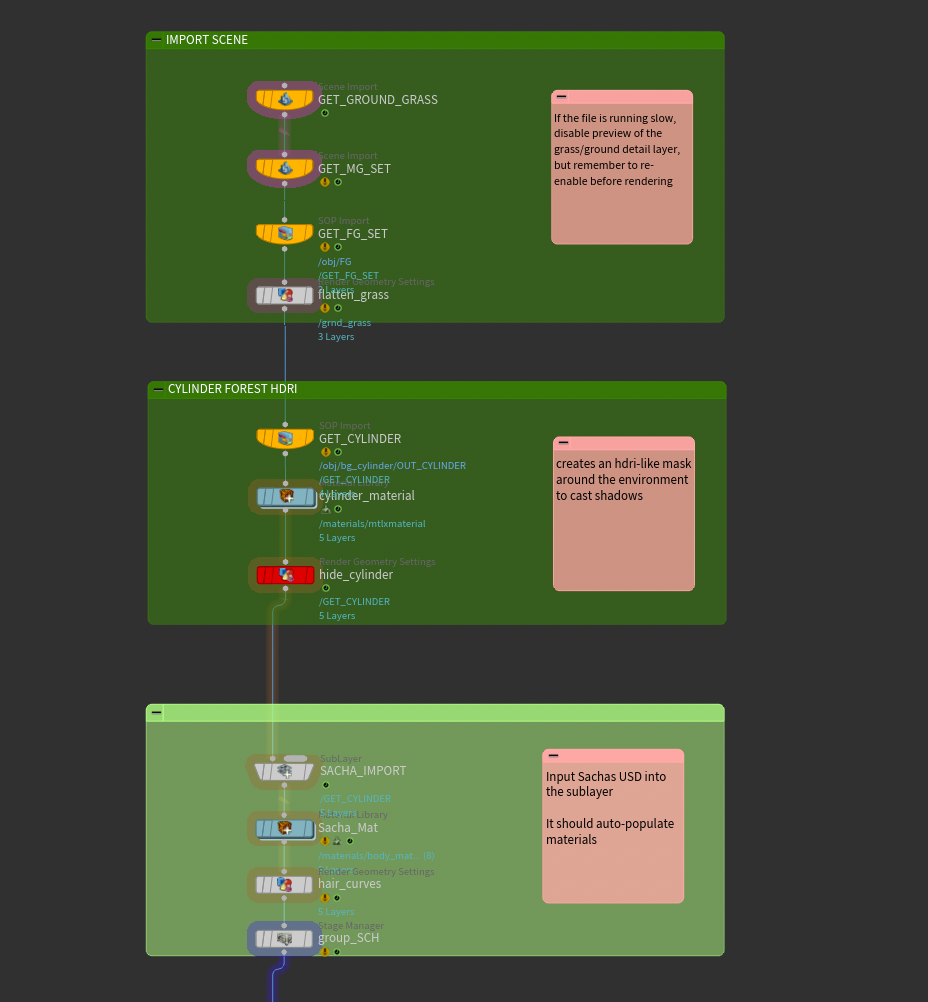
Lighting is being done in Houdini LOPS.
I had organized the stage setup to easily combine all assets, and import our USD's from CFX (see more in Rendering / Optimization section below).
Materials were all assigned correctly by tech lead Ludovica Biscarini. CFX rendering set-up created by CFX lead Mia Laplanche.

In the base file, we created different template lighting set-ups for each main sequence.

These allow for easier continuity and visual consistency.
In comp, we combine separate renders of the background, midground, characters, and effects in Nuke.
RENDERING / OPTIMIZATION
Taking place mostly in a forest, our film is very heavy. With elements such as grass, trees, leaves, instanced sticks / flowers, plants, rocks, and character effects, there was a lot to juggle in optimizing our workflow and accomodate for any technical limitations.
Because of this, we opted to render out of Houdini Karma, as to avoid transferring heavy files between softwares. This also allowed us to utilize a USD workflow.
Pipeline & USD Workflow
MAYA -> HOUDINI (CFX) -> HOUDINI (LIGHTING & FX) -> NUKE (COMP)
In our pipeline, animators animate in Maya, then the CFX department brings the animated models into Houdini to create hair and cloth sims.
In the meantime, lighters and effect artists work in a separate file on lighting the set and creating simulations. Once CFX is completed, the CFX artist sends a USD of the characters to the lighters, where they combine everything and render the EXRs on the Render Farm for compositing.
Environment Creation
All of the plant models seen in the film were modeled by our team members. Since we were aiming for purposeful shapes, with swirls and confident, natural silhoutes, we wanted to have artists hand modeling and texturing any assets possible.

I had hand-placed the plants, trees, and rocks seen in the foreground, to create a more purposeful shape along the edge of the forest. While also scattering some smaller plants in between them as well. The grass is also procedural, using the hair system in Houdini.
All of the assets were packed accordingly to optimize geometry, as well as named, to be later pulled into LOPS.
Background Forest & Camera Culling

The background forest seen behind the hand-modeled assets is created procedurally. I had utilized the Houdini Labs Tree Generator system to create trees to fill the space, and make it feel truly like a crowded forest.
The trees also are able to be culled to the camera, allowing for less geometry when rendering out USD's to send to the Render Farm.
Solaris & Rendering
Here is the setup for the set lighting file, where characters are imported from CFX and the set is brought together.
CREDITS
Directors
Cata Fierro
Anca Dubalaru
Producer
Carson Alverson
Leads
Mackenzie Bayless - Animation
Austin Bookman - Layout
Ludovica Biscarini - Tech / Co-Lighting / Production Assistant
Mia Laplanche - CFX
Team
Aakash Mandava
Alec Gold
Alexandra Murphy
Delphine Peck
Jessica Marcus
Kendrick Lam
Madison Jennings
Matthew Aureli
Max Wu
Peter Shanley
Reilly Lamb
Sania Khullar
Sanika Godbole
Nidhi Jallepally
Xiomara Hernandez
Sydney Relkin

Comments